Current State
Each discipline mapped its process across six stages, using the same prompts to capture what started the work, who was involved, and how long it typically took.

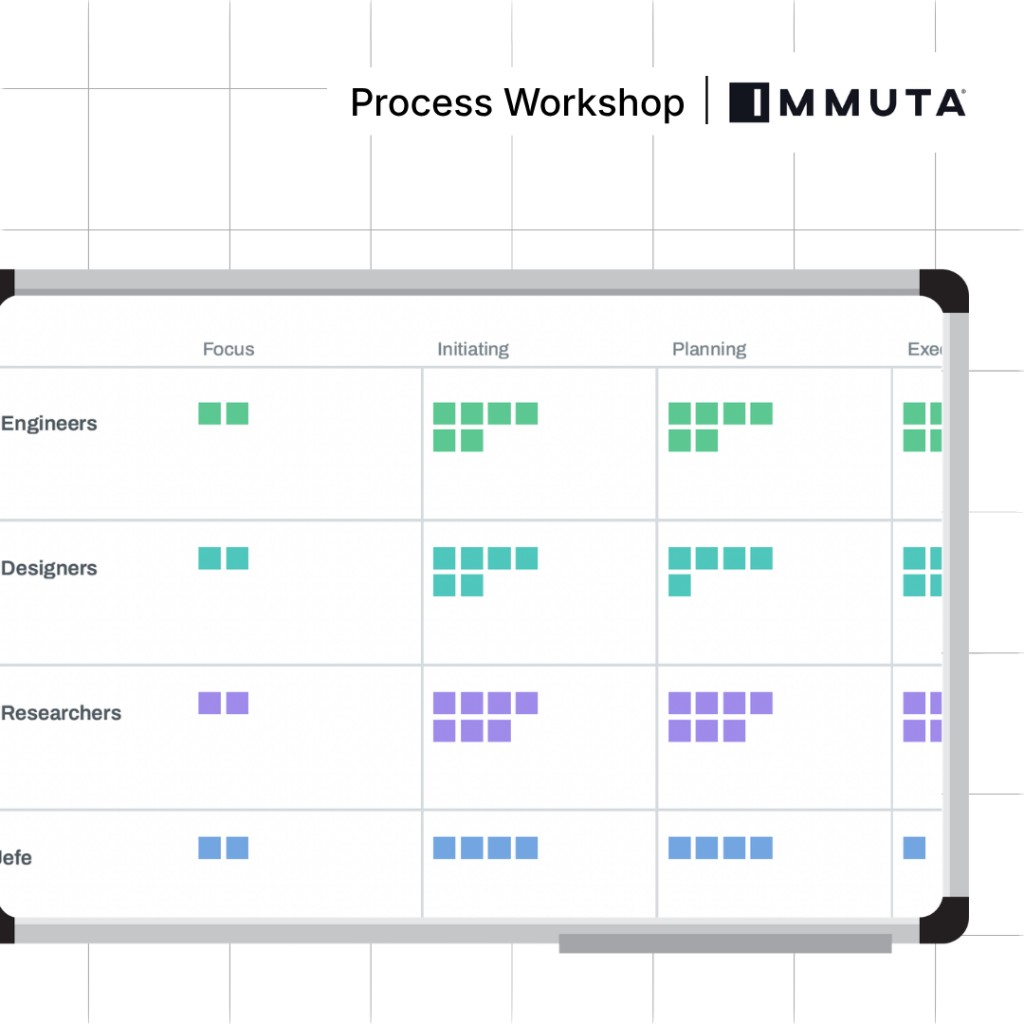
Aligning Design, Research, and Engineering around a shared delivery process to improve planning, ownership, and cross-functional collaboration.
Client
Immuta
Enterprise SaaS · Data Security
Role
Senior Product Designer
Category
Year
2023
Problem
As Immuta’s UX organization grew, Design, Research, and Engineering developed different ways of planning and delivering work. This made handoffs less consistent, dependencies harder to track, and it wasn’t always clear when work was ready to move from one team to the next.
Teams estimated work differently.
Ownership and timing weren’t always clear.
Design often became a bottleneck.
Timing and ownership weren’t always clear.
Work sometimes started before the previous stage was complete.
Planning
Teams estimated work differently.
Handoff
Ownership and timing weren’t always clear.
Execution
Design often became a bottleneck.
Review
Timing and ownership weren’t always clear.
Completion
Work sometimes started before the previous stage was complete.
Dependencies were handled informally.
Objective
The goal was to understand how work moved across Design, Research, Engineering, and UX Leadership, then use that shared view to identify gaps and create a more consistent way of working together.
Workshop goals
Workshop
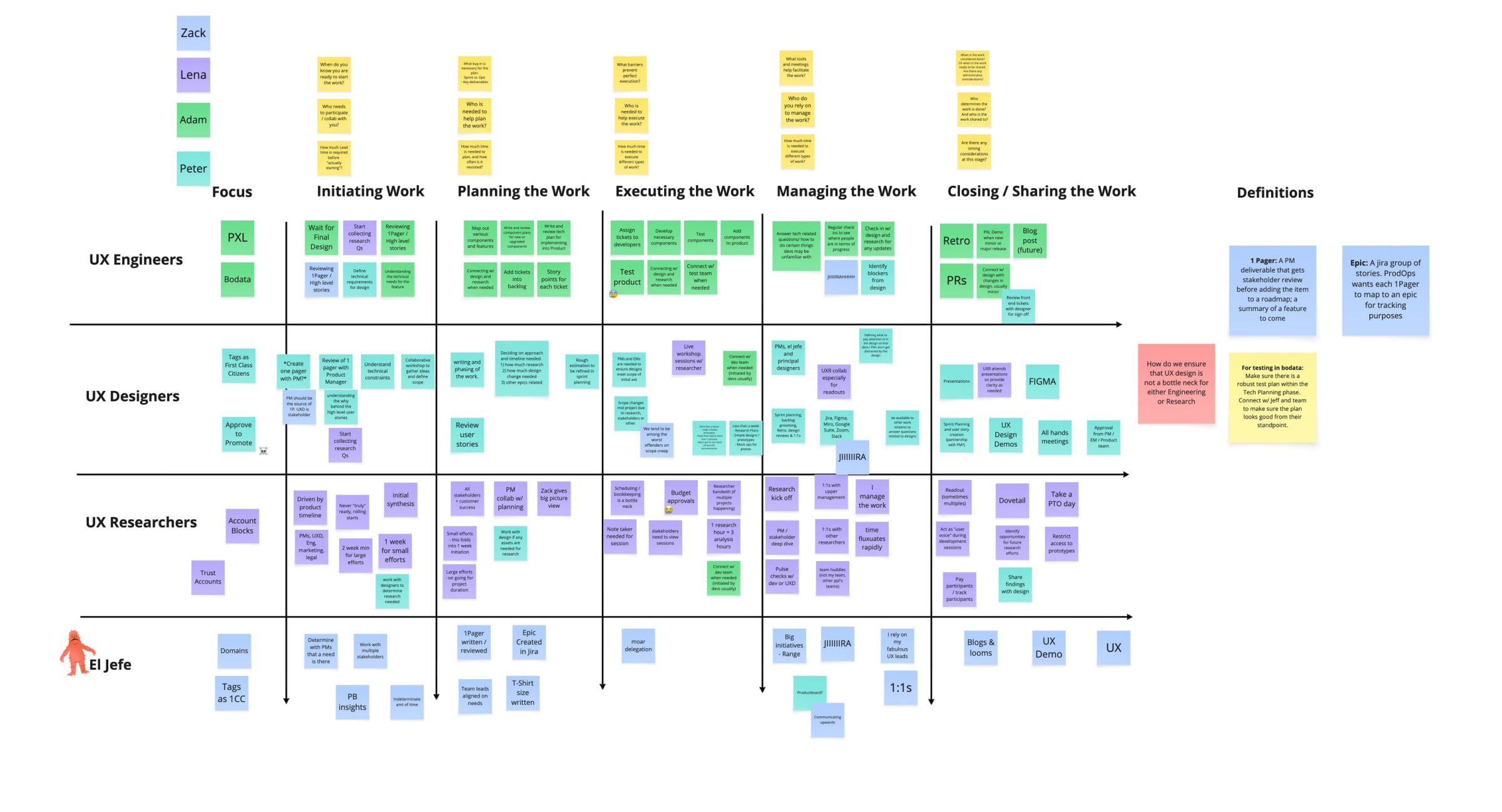
I designed and moderated a workshop that brought Design, Research, and Engineering together to map how work actually moved across UX. Instead of jumping into solutions, I structured the session around three activities that helped us understand the current process, how teams worked together, and where expectations differed.
Each discipline mapped its process across six stages, using the same prompts to capture what started the work, who was involved, and how long it typically took.
We mapped recurring meetings by team and frequency to understand where teams connected and which meetings depended on one another.
We compared how each discipline defined key stages and milestones to uncover where teams were working with different expectations.
Each discipline mapped its workflow using the same three questions: What starts the work? Who needs to be involved? How much time does it take?
Using the same structure across teams made it easier to see where their processes aligned, where they differed, and where dependencies existed.
Insights
Looking across the workshop boards, recurring patterns began to emerge. Four key insights shaped the operating model that followed.
01
Teams relied on Design at different points in their work. Engineering often waited for final designs, while Research and Product added new inputs along the way. The workshop made these dependencies easier to see.
02
Each discipline had its own idea of when work was complete. Without a shared definition, one team could be finished while another still had work to do.
03
A lot of the team’s planning and estimation lived in people’s heads. The workshop helped bring that knowledge into the open so teams could plan from the same starting point.
04
Scheduling, recruiting, budgeting, and approvals took up a lot of the Research team’s time. Mapping the process showed where operational work was taking time away from research.
Outcome
We established a consistent meeting cadence across Research, Design, Engineering, and UX Leadership. Organizing each meeting by team and frequency clarified when teams needed to connect, how one meeting informed the next, and where broader UX alignment happened.
Cadence
Note
Rather than adding meetings for the sake of process, each ceremony answered a specific breakdown identified on the current-state board.
The workshop surfaced how planning, reviews, and handoffs were actually happening across teams. Mapping these recurring touchpoints made dependencies visible and helped us identify where greater alignment was needed.
5 ceremonies
Per sprint cycle
Each team reviews the sprint, identifies issues to bring to the broader UX team, and prepares completed work for demo.
Individual teams review upcoming work, priorities, and capacity for the next sprint.
UX teams come together to review sprint plans, workloads, priorities, and cross-team dependencies.
UX leads review plans across teams and adjust scope or priorities to ensure the upcoming sprint is realistic.
A recurring operating cycle: after UX Retro + Demo, Team Refinement kicks off the next sprint.
Impact
The workshop gave Design, Research, Engineering, and UX Leadership a shared process for planning work, managing dependencies, and staying aligned.
Teams had a common way to talk about stages, ownership, and timing.
Dependencies and ownership became easier to see across teams.
A shared cadence created clearer points for refinement, prioritization, and sprint planning.
The team had a documented model they could continue using and refining as the organization evolved.
This project reinforced that not every UX problem is solved in the product. Sometimes the challenge is how teams plan, communicate, and make decisions together. By making the process visible, we were able to have clearer conversations about what wasn’t working and build a more consistent way of working across UX.
Start by understanding how work actually happens
Mapping the current process before proposing changes helped us focus on real problems instead of assumptions.
Use structure to create better conversations
Giving each team the same questions made differences in ownership, timing, and expectations easier to see and discuss.
Design the process around the problems
The goal wasn’t to add more meetings. Each change to the team cadence was tied back to a gap we uncovered during the workshop.
Next project: Designing for Cross-Functional Alignment
VIEW NEXT PROJECT